Sustainable business scaling is often misunderstood by SME founders in the interior design and beauty industry. Many believe scaling simply means getting more clients, hiring more staff, and expanding locations. In reality, sustainable business scaling means growing revenue faster than costs while maintaining quality, brand value, and operational stability. Without this balance, growth turns into pressure rather than progress. For founders navigating competitive markets, the real challenge is not just scaling operations but ensuring that scaling actually improves profitability. This is where most businesses fail, especially when external forces like demand shifts and competition are ignored. Understanding how sustainable business scaling works in real market conditions is what separates stable businesses from those that collapse under growth.
The Hidden Drivers Behind Sustainable Scaling
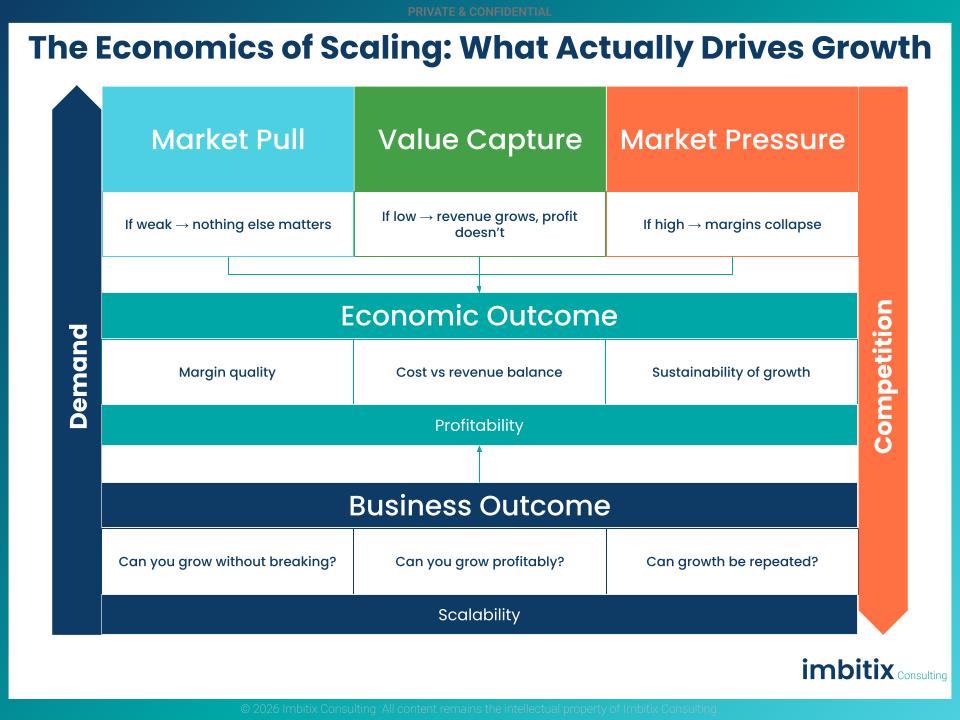
Most founders focus on internal efficiency when thinking about sustainable business scaling, but external forces play an equally critical role. Market demand determines whether your increased capacity will actually convert into revenue. At the same time, competition affects pricing power and margins, which directly impacts scalability. If your business cannot capture value in a competitive environment, scaling only amplifies inefficiencies. Sustainable scaling happens when your unit economics remain strong even as you grow. This means your cost to serve does not rise at the same rate as your revenue. Without this alignment, scaling becomes risky rather than strategic.
Scaling a business requires more than just increasing output. It demands a model where revenue grows faster than the underlying cost structure.
This is especially important for design and beauty SMEs where service quality and customer experience directly impact retention. External pressure will quickly expose weak systems.

When founders ignore these forces, they scale blindly. When they understand them, scaling becomes predictable and controlled.
Growth Alone Is Not Scaling
There is a critical difference between growth and sustainable business scaling that many SME founders overlook. Growth often means increasing resources at the same rate as revenue, such as hiring more staff for more clients. Scaling, however, means generating more revenue without proportionally increasing costs. This distinction is what determines long term success. In industries like interior design and beauty, where labor and time are core constraints, this difference becomes even more important. Without scalable systems, every new client increases operational strain. True scaling requires redesigning how value is delivered, not just increasing output.
Plateau
Many businesses reach a plateau because their model is not designed to scale efficiently.
Inconsistency
They rely heavily on manual processes, founder involvement, and inconsistent pricing strategies. As demand increases, complexity rises, and margins shrink. This creates a situation where more business does not translate into more profit. In fact, it often leads to burnout and declining service quality. Sustainable business scaling solves this by aligning delivery systems, pricing, and positioning with market demand.
Without this shift, growth becomes a burden rather than an advantage.
Value Capture Determines Scalability
One of the most overlooked elements of sustainable business scaling is value capture. Many SMEs focus on delivering value but fail to capture it effectively through pricing, positioning, and differentiation. In competitive markets, this becomes a major limitation. If your pricing does not reflect your value, scaling will only increase workload without improving profitability. Value capture ensures that every additional client contributes meaningfully to your bottom line. It also protects your business from price based competition.

Beyond
For design and beauty founders, this means moving beyond hourly pricing and commoditized services.
Structured
Instead, it requires structured offers, clear positioning, and strong brand perception that supports premium pricing.
How to Know If You Are Ready to Scale
Before pursuing sustainable business scaling, founders need to assess whether their business is truly ready. Scaling too early can amplify weaknesses and create operational chaos. A scalable business typically has consistent demand, predictable delivery systems, and strong unit economics. It also has a clear understanding of its target market and competitive positioning. Without these foundations, scaling becomes guesswork. The smartest approach is to diagnose readiness before making growth decisions.
Self Diagnosis for Growth Readiness
A structured diagnosis helps identify gaps in systems, positioning, and profitability.
You can start by evaluating your demand consistency, pricing power, and operational efficiency. If any of these areas are unstable, scaling will expose the weaknesses. For a deeper breakdown, explore how to self diagnose for growth readiness to understand where your business stands and what needs to be fixed before scaling.
Conclusion
Sustainable business scaling is not about doing more. It is about doing better with stronger systems, clearer positioning, and a deeper understanding of market forces. For interior design and beauty SME founders, the difference between growth and scaling determines whether expansion leads to profit or pressure. If you are unsure whether your business is ready to scale, the next step is clarity. Get a professional diagnosis to identify gaps and opportunities before making costly decisions. This is how you scale with confidence and not just ambition.